When democracy is under attack, what can people do? “Stand up, fight back!” goes the street chant. But is that enough?
Yes, resisting attacks is important. But defending the status quo alone is a losing strategy when most people don’t like the current system of government. Most people in the United States, across nearly all demographic groups and ideologies, say that the nation’s government does not work for them, according to a Times/Siena College poll. Worldwide, the Pew Research Center found in 2021 that most people in electoral democracies think “their political system needs major changes or needs to be completely reformed.”
These people are not wrong. A decade ago, political scientists Martin Gilens and Benjamin Page concluded that “economic elites and organized groups representing business interests have substantial independent impacts on US government policy, while average citizens and mass-based interest groups have little or no independent influence.” It’s no wonder people want change!
While rising polarization and anti-immigrant sentiment are highly visible, they are symptoms of democratic backsliding rather than causes.
Making systemic changes to democracy isn’t easy. Too often, we look for one magical solution that will change everything. Democracy advocates around the world have identified more promising approaches. Based on this work, I suggest that we focus our attention on three emerging strategies for democracy renewal:
- Roots: Address the hidden root causes that are driving democratic backsliding.
- Horizons: Envision and start building the desired future of democracy.
- Ecosystems: Build bridges, infrastructure, and narratives to connect existing efforts.
Unfortunately, only a sliver of democracy funding and work currently aligns with all of these strategies. In the United States most funding focuses on maintaining and defending existing systems of electoral democracy—it’s time to move beyond defense and put these alternative strategies into practice.
How to Address the Root Causes
Democratic practices of governance are in crisis, and we need to first understand the underlying ailments if we want to fix them. Otherwise, we may end up just treating the symptoms.
The Democracy Iceberg framework developed by Philea, the Philanthropy Europe Association, helps distinguish the causes of backsliding from the symptoms. It maps root causes of people’s frustration, catalysts that amplify this discontent, and the resulting visible symptoms. While rising polarization and anti-immigrant sentiment are highly visible, they are symptoms of democratic backsliding rather than causes.
According to Philea, unmet needs, unheard emotions, and systemic failures are the root causes driving polarization and anti-immigrant sentiment. When people are struggling to pay their bills, feel that their voices aren’t being heard, and think that the system is broken, they are more susceptible to polarizing “us-versus-them” rhetoric and more inclined to blame others for their problems.
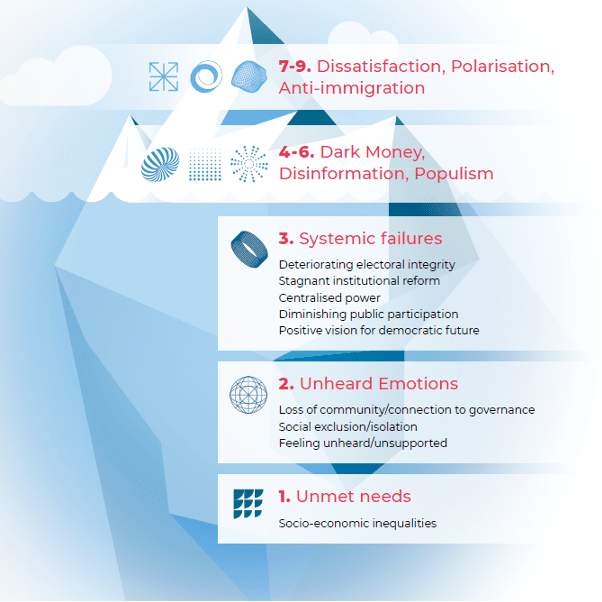
To alleviate the symptoms of democratic backsliding, advocates need to address the root causes by changing how democratic institutions work. This can be accomplished by:
- To respond to unmet needs, reshape policymaking for these needs. Campaigns and programs that increase people’s decision-making power over essential goods and services, such as housing and healthcare, show how democracy can meet people’s needs. This requires a mix of organizing, policymaking innovation, research, and communications to create a clear link between people’s democratic engagement and resulting material benefits. Of course, this kind of organizing means contesting for power and challenging powerful forces, such as private equity owners of housing and healthcare, that have stood in the way of giving people meaningful control in these areas.
- To address unheard emotions, develop spaces for social and emotional connection. Community dialogues, legislative theater, and artistic and cultural engagement invite people to express themselves emotionally and listen to their neighbors. This may involve bringing public voices into existing policymaking, setting up new spaces and programs, and researching how to make democracy resonate with people emotionally.
- To fix systemic failures, invite people to change the system. This can be done by expanding programs that help people participate in decision-making and fix bureaucratic inefficiencies. For example, citizens’ assemblies convene groups of randomly selected citizens to determine community priorities and develop solutions. Participatory budgeting invites residents to decide how to spend public funds. Participatory policymaking engages masses of people in shaping public policies. These innovations build trust and democratic muscle by making policymaking much more responsive to the public’s needs.
But reversing the current problems is only part of the puzzle—we also need better solutions for the future.
Envisioning Future Horizons
If the status quo is deeply flawed, how can we build meaningful and accountable democratic governance? Programs such as the Democracy Futures Project of PACE (Philanthropy for Active Civic Engagement) are envisioning paths forward. This 18-month program aims to help 60 participating funders spot trends and think long-term about US democracy.
Of course, while the PACE program is directed at funders, a longer time horizon is vitally important for nonprofits and movement actors as well. PACE and others are using this future thinking to better understand what to keep from the current system, what emerging practices to explore, and what seeds of future change to support.
To read the full article on Nonprofit Quarterly, click here.